Build a ferry line
Ferries carry people across water, to islands, across harbours and along rivers. You don't need to build track, so a ferry is cheap to set up. But boats are slow and can be expensive to run for the number of people they carry.
When is a ferry worth it?
Build a ferry where a bridge or tunnel would cost too much, or where an island has no road connection. Ferries work best when they save people a long journey around the water.
A ferry also needs other lines to bring passengers to its piers. On its own, it may carry only a few hundred people a day. Put a bus stop or station near each pier so people can change to the boat.
The real Staten Island Ferry carries about 45,000 people a day, helped by buses and the island's railway bringing passengers to the pier.
In Hong Kong, Cheung Chau, Peng Chau and Lamma can only be reached by boat. Look for these islands in Hong Kong's city requests.
Start a ferry line
Click + in the top bar, then select the ferry icon in the line card. It's the last of the five icons.
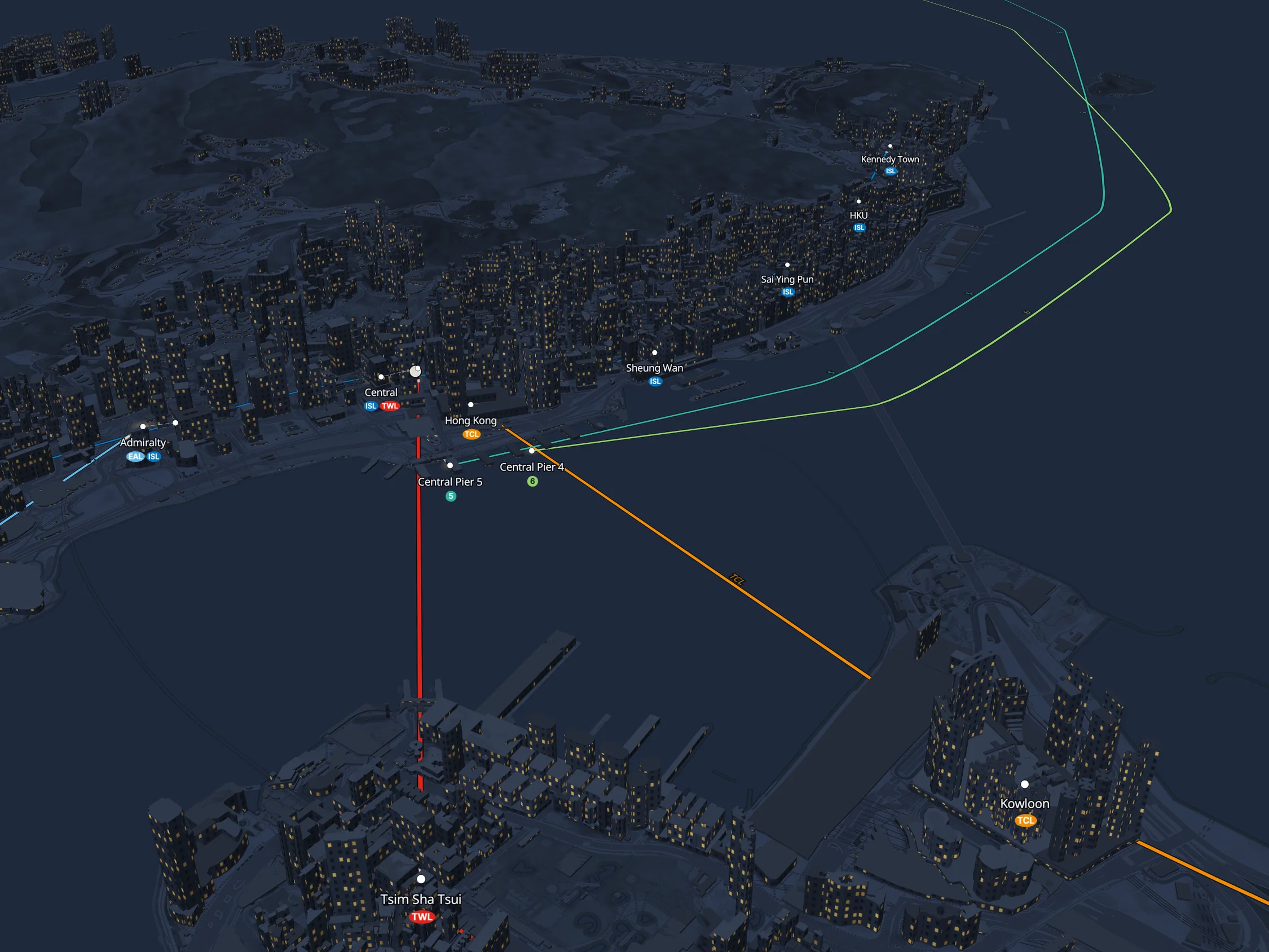
Place your piers
Piers are ferry stations where people get on and off the boat.
Click near the water to place a pier. You can put it on a quay up to 150 metres from the water, or out on the water up to about 70 metres from the shore. Click further out and you'll place a waypoint instead.
Move the pointer to see where the pier will stand before you click. The pier extends out from the shore, and the boat stops at its far end.
Start with 1.5–10 kilometres between piers. People will walk up to 800 metres to reach one, so place piers near homes and workplaces, ideally with a bus stop or station nearby.
Boats travel at up to 24 km/h. They slow down when approaching a pier. An 8-kilometre crossing takes more than 20 minutes, so keep the journey time in mind when choosing your route.
If you're too far inland, the card says "Too far from the water · place the pier near the shore". Your first click must place a pier near the shore, not out on the water.
Piers are about 35 metres long, or up to 70 metres if you point further out. On narrow rivers, they reach no more than a third of the way across.
Piers must be inside the city boundary, but your route can cross water outside it.
Steer around land with waypoints
Ferries must stay on the water. If the route between two piers crosses land, the track turns red and the card says "Route crosses land · add a waypoint to sail around it".
Click on the water to place a waypoint. The boat passes through it without stopping. Use waypoints to sail around headlands and islands, or to follow bends in a winding river. Waypoints are free.
Near the shore, clicking normally places a pier. Press W to place a waypoint instead, and S to switch back to piers.
Waypoints must be on the water. The card tells you if you click on land. Only the final few metres leading to a pier may cross land, where the boat reaches the quay.
To add another pier along an existing route, click the route where it passes close to the shore.
Choose your boats
Open Vehicles in the line card to choose a different boat. You can do this before building the line.
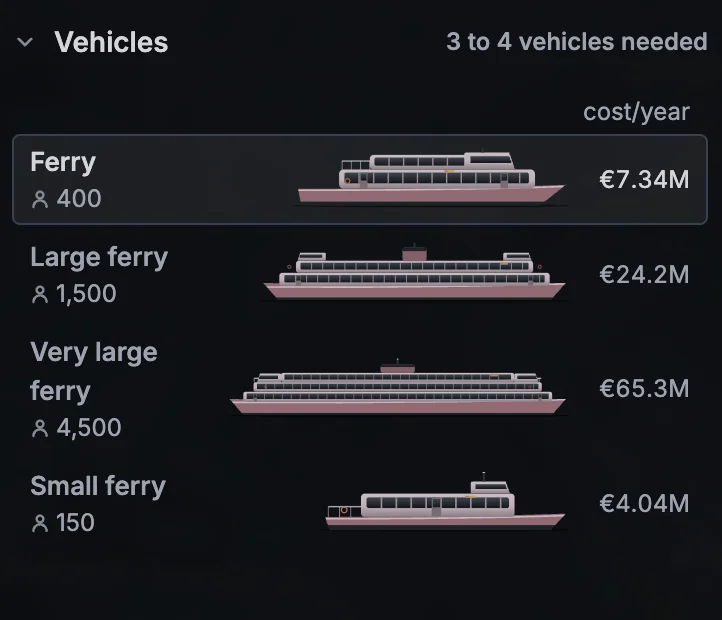
| Boat | Passengers | Best for |
|---|---|---|
| Small ferry | 150 | Routes with fewer passengers |
| Ferry | 400 | The standard boat |
| Large ferry | 1,500 | Busy routes |
| Very large ferry | 4,500 | Routes with very high demand |
The standard ferry is the boat every new line starts with.
All four boats have the same top speed of 24 km/h. Larger boats cost more to run. A large ferry costs about three times as much as a standard ferry, and a very large ferry almost nine times as much. Choose a boat that fits the number of people using the route.
Large ferries have two gangways, and very large ferries have wide ramps, so passengers can board faster.
New boats are added to your plan and start running when you finish the year.
Check the cost and run your line
The piers and boats cost money. The route across the water is free to build, and so are waypoints.
The line card shows the construction cost before you click. It includes any new pier at either end of the section. Each pier is charged only once.
Running the boats is the expensive part. Longer routes and more frequent service cost more to operate. After the first year, check Results to see whether the fares cover the running costs.
When you're ready, click Finish 2026 and confirm the plan to run your line. See Quick start for the full process.
Share a pier
Two ferry lines can stop at the same pier. Start or end the second line at a pier already used by the first. Each line pays for its own place at the pier.
Unlike railways, ferry routes don't use shared or parallel track. Other lines can't branch off a ferry route, share it or run alongside it.
Ferries also can't run in a loop. The route must end at a different pier, and the card tells you if it doesn't.
A pier doesn't automatically connect to a nearby bus stop or railway station. People walk between them, and the card shows the walking distance. Keep the transfer short if you want people to use it.
Set how often boats run
Open Takt in the line card. Ferries have four preset options: Harbour, Peak, Half-hourly and Hourly.
Boats can leave as often as every 5 minutes. See Set the takt for details.
Each boat spends about two minutes at a pier, and longer when lots of people board or leave. At each end of the route, it waits about eight minutes before sailing back.
Check how your ferry is doing
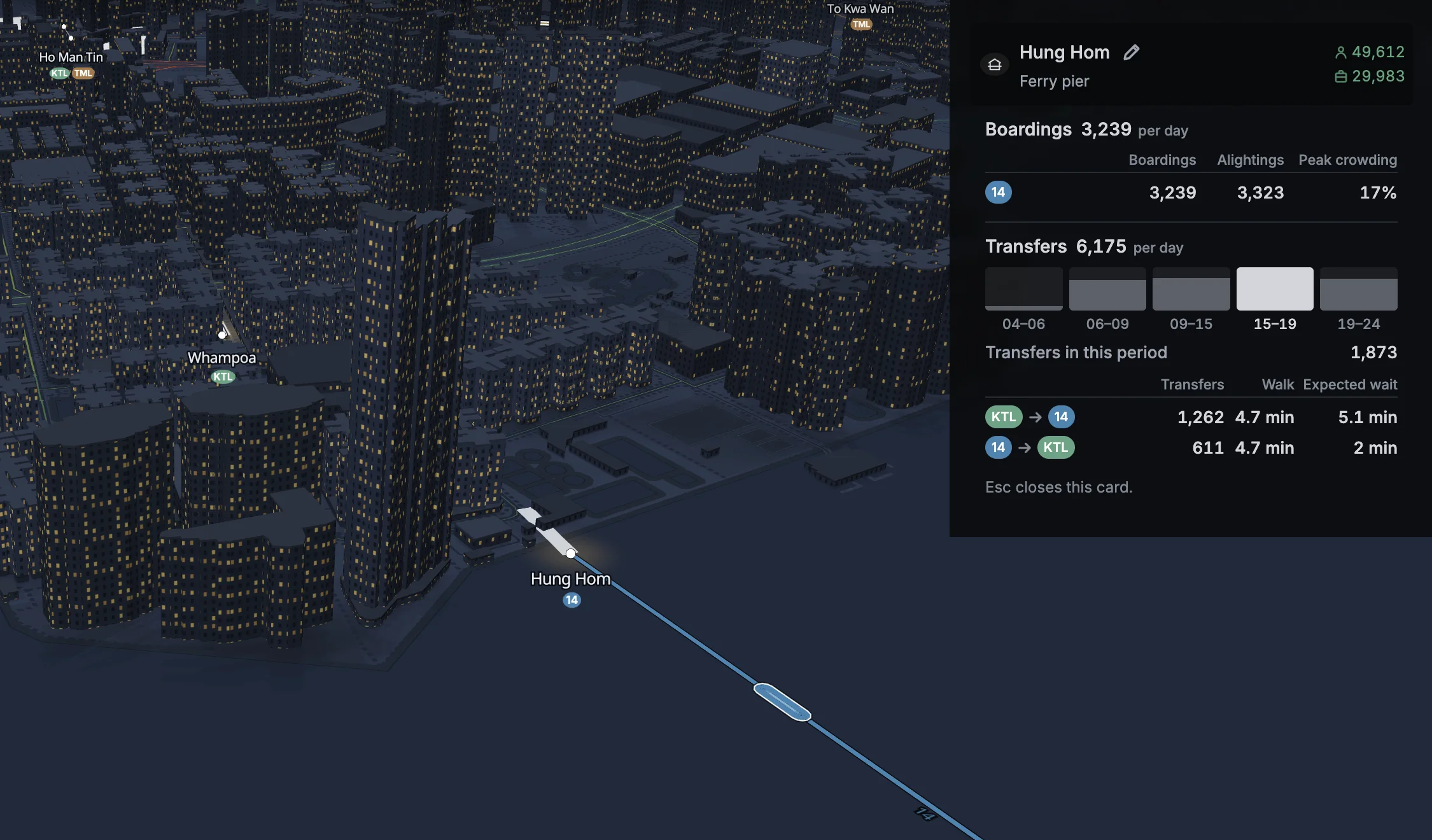
After the year ends, open the line card and check Takt and Results.
Click a pier to open its card. You'll see how many people board and leave each line, how many transfer between lines, and how long they spend walking and waiting.
If your boats carry very few passengers, check whether people are changing to the ferry at either end. If not, connect a bus or train line to the pier.
Hourly boats can also mean long waits that put people off. Try Peak or Harbour before giving up on the route.
If the boats are full, run them more often first. If that's not enough, choose larger boats under Vehicles.
Change a built route
To replace a section of a ferry route, click Bulldozer in the line card, then click the section you want to remove. You can draw the replacement section again from either end of the gap.
You can also split a ferry line into two at a pier. Open Operations and choose Split line.
The changes are added to the year's plan automatically. See Change a line for removal costs and other changes.
Ferry facts
- Capacity: 400 passengers per standard ferry; 150 for a small ferry, 1,500 for a large ferry and 4,500 for a very large ferry.
- Walking distance: Up to 800 metres to a pier.
- Typical gap between piers: 1.5–10 km.
- Shortest takt: 5 minutes.
- Top speed: 24 km/h; boats slow down when approaching piers.
- Pier cost: €8M in Berlin and Amsterdam; about 2.3 times as much in Hong Kong and New York, where prices are in dollars. Costs follow each city's building costs.
- Running cost: €1,000 per boat per day, plus €60 per kilometre sailed.